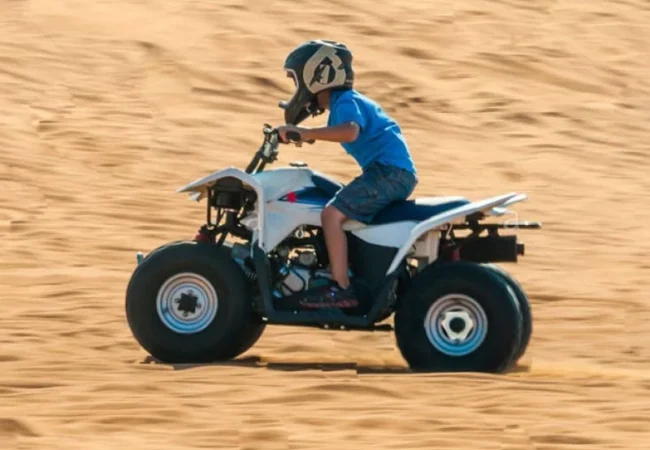
 AED 150
Yamaha 90cc
- Ages 9-12
- Track
- Supervised
Small loop, low seat, throttle capped so a jumpy first grip never gets away from a child.
Book this ATV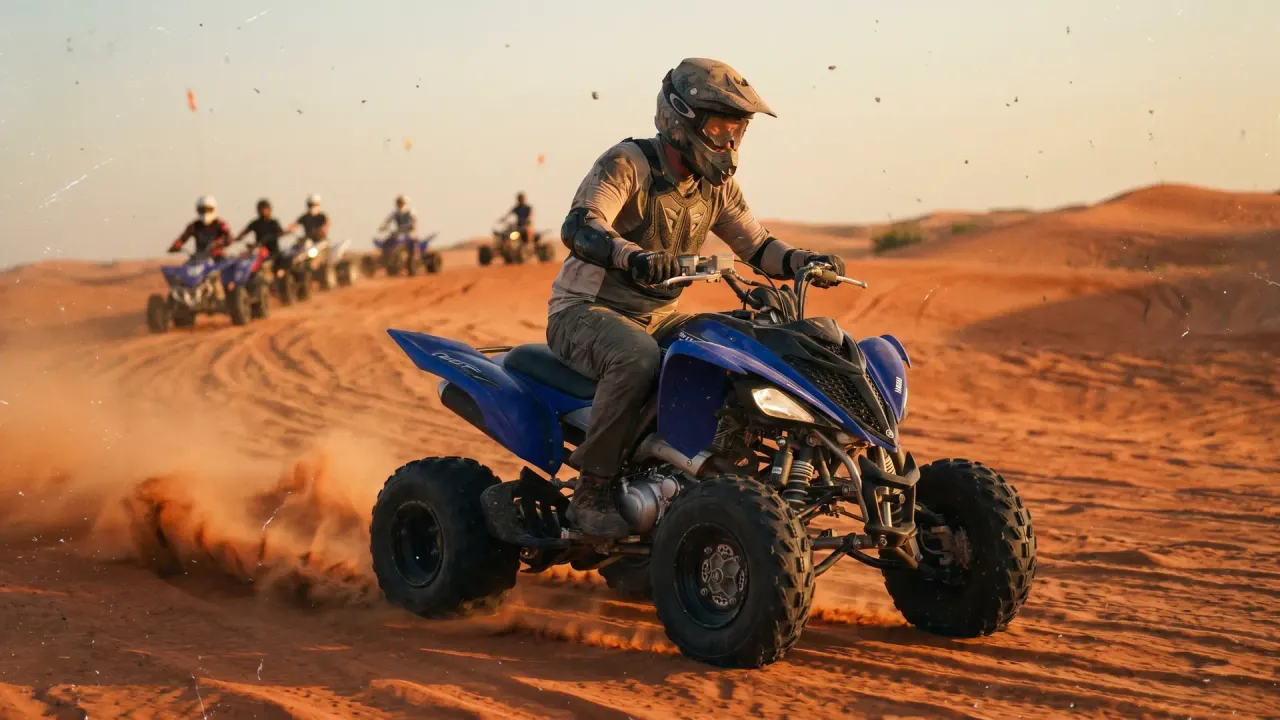
The first proper climb tells you everything a fenced-in track never could. Weight back, throttle steady, the dune lets go right at the lip and drops you into the next bowl. You ride your own Yamaha the whole way, not a rental queued behind ten others, sized to what you can actually handle: a supervised 90cc for children up to the Raptor 700cc for riders who ask for it by name.
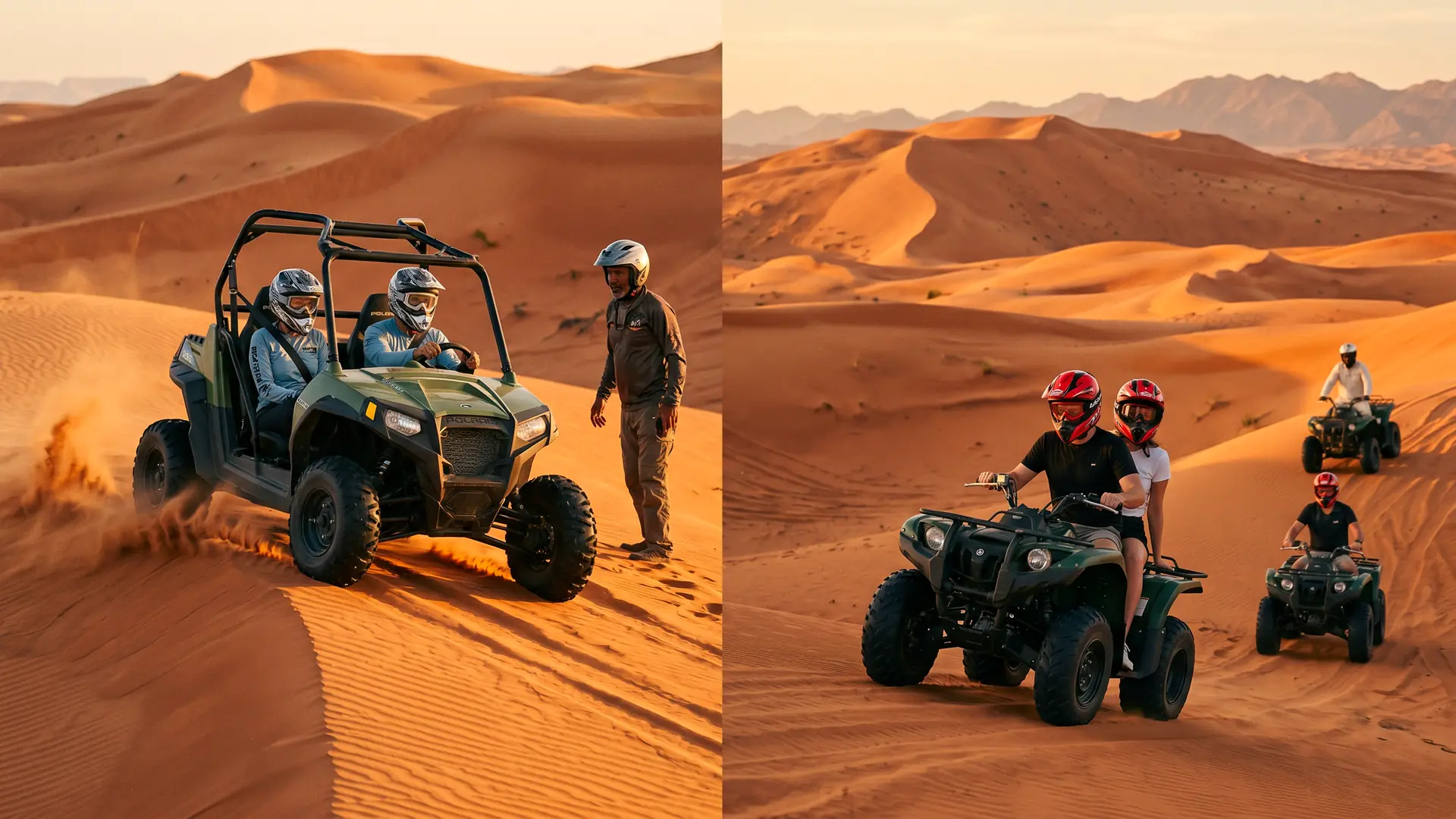
An ATV ride at Al Lahbab puts you on your own Yamaha for a guided run through red dune bowls roughly 45 minutes southeast of Downtown Dubai, one rider per machine, the guide setting the line after watching how you handle a warm-up. AED 200 buys the gentlest adult machine, the 220cc; AED 795 the fastest, the Raptor 700cc. Most sessions run on the 400cc in between, at AED 250. A separate 90cc loop, supervised throughout, covers riders from nine to twelve at AED 150.
Riders who want the fullest day usually book the Evening Desert Safari with ATV and BBQ at AED 375, the busiest single package in the whole catalogue: dune bashing, your own riding session, then dinner at the camp. Secure online advance payment confirms your booking, support available 24/7.
One rider, one machine, one price, with a single built-in exception: the 400cc double, which seats two for a shared fee. Whatever ends up under you, the meter does not start until route, timing and pickup have all been agreed.
| Machine | Suits | From |
|---|---|---|
| Yamaha 90cc | Ages nine to twelve, supervised track, a guardian watching from the side. | AED 150 |
| Yamaha 220cc | Never gripped a throttle before. Light in the hand and forgiving of a heavy wrist. | AED 200 |
| Yamaha 400cc | What most sessions default to. Handles the standard route without asking much of you. | AED 250 |
| Yamaha 400cc double | One machine, two riders, one fee between you. | AED 350 |
| Yamaha 400cc turbo | Same frame, more punch out of every bowl. What repeat riders book. | AED 350 |
| Yamaha Grizzly 450cc | Heavier and planted. Worth asking for on the longer routes. | AED 450 |
| Sports quad 625cc | Sharp and unforgiving of a lazy line. For riders with real hours logged. | AED 700 |
| Yamaha Raptor 700cc | Quickest machine on the fleet. Handed over only after a short rider check. | AED 795 |
Every ride is guided, so the machine you pick shapes comfort more than difficulty. Choose the one your hands and shoulders can hold for the whole session, and the guide fits the route around it.
AED 150Small loop, low seat, throttle capped so a jumpy first grip never gets away from a child.
Book this ATV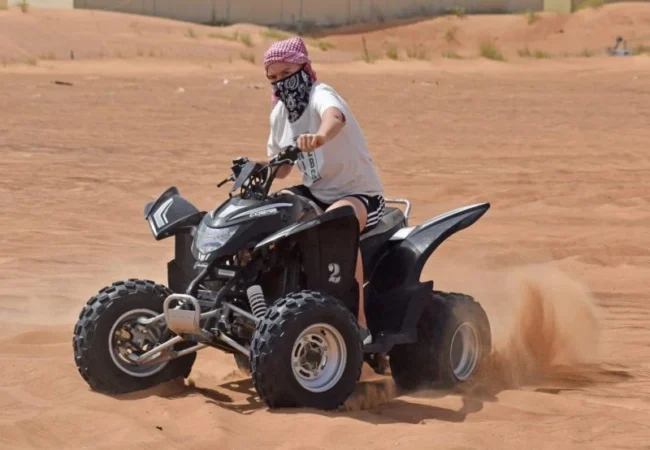 AED 200
Soft power delivery that never snaps under a jumpy hand. Most first-timers finish wanting a longer ride, not a bigger one.
Book this ATV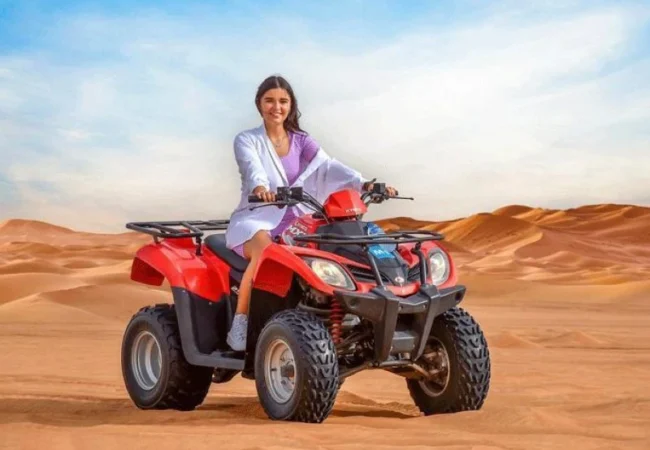 AED 250
Enough torque to climb without you working for it, not so much that a mistimed throttle punishes you.
Book this ATV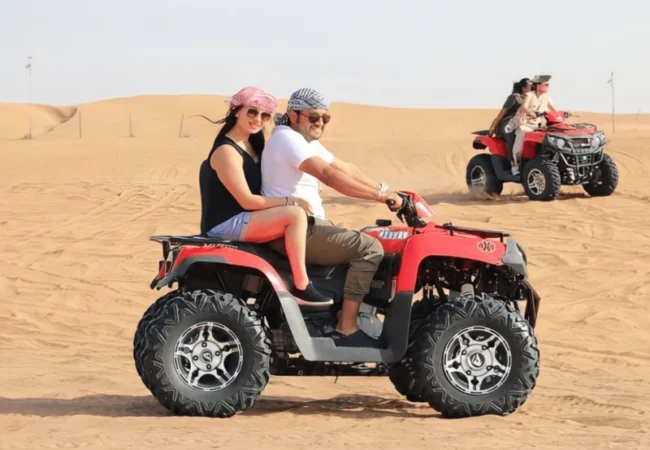 AED 350
One saddle, two riders. The seat behind sits high enough to see a bowl coming before the driver reacts to it.
Book this ATV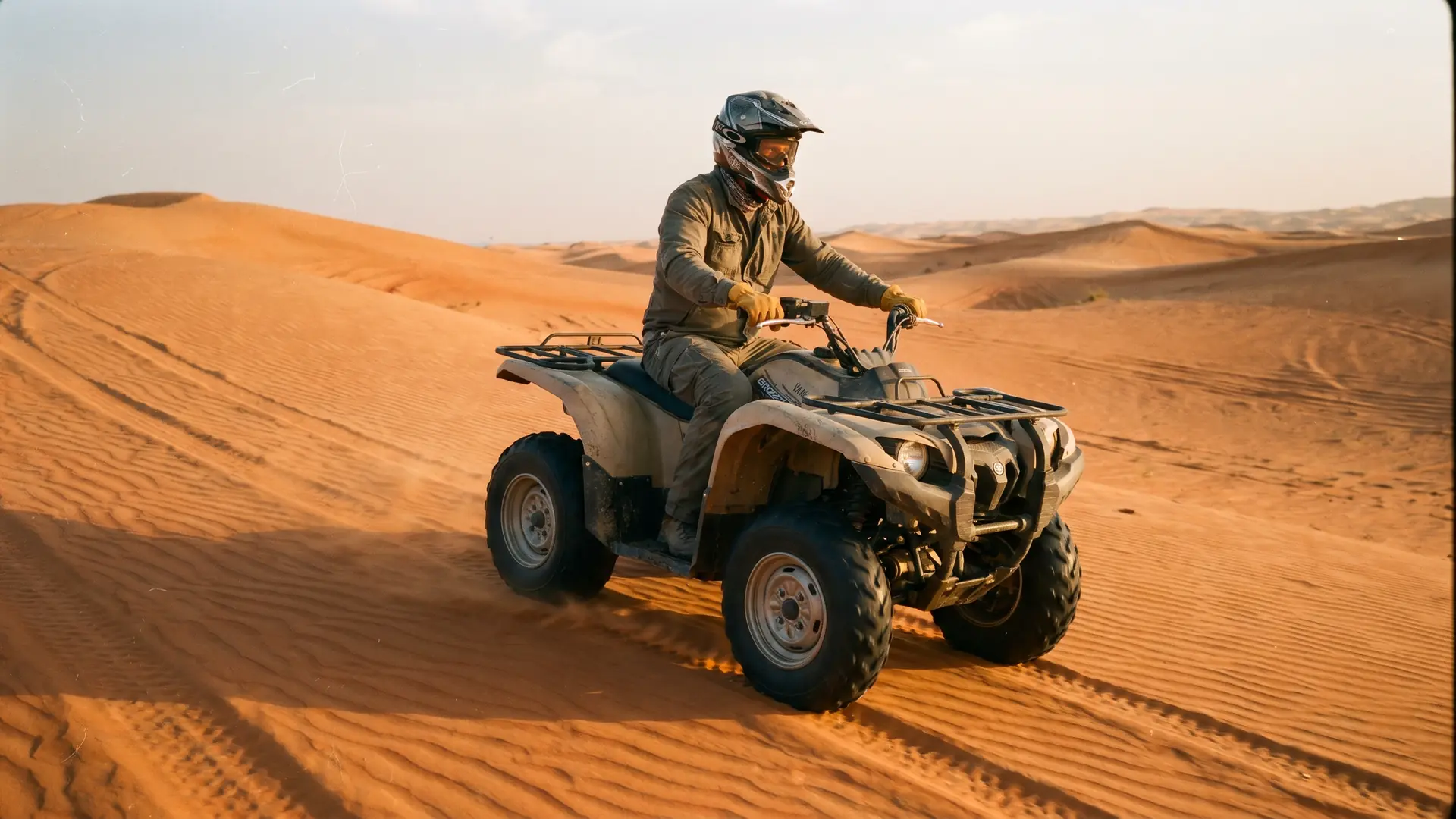 AED 350
Same seat position as the standard 400, with a shove out of the bowls that catches first-time turbo riders off guard.
Book this ATV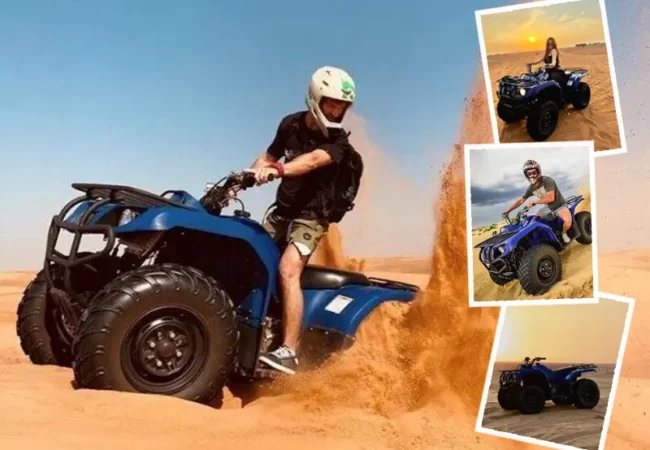 AED 450
Extra weight over the front wheels keeps the nose planted on broken ground where lighter machines skip and dart.
Book this ATV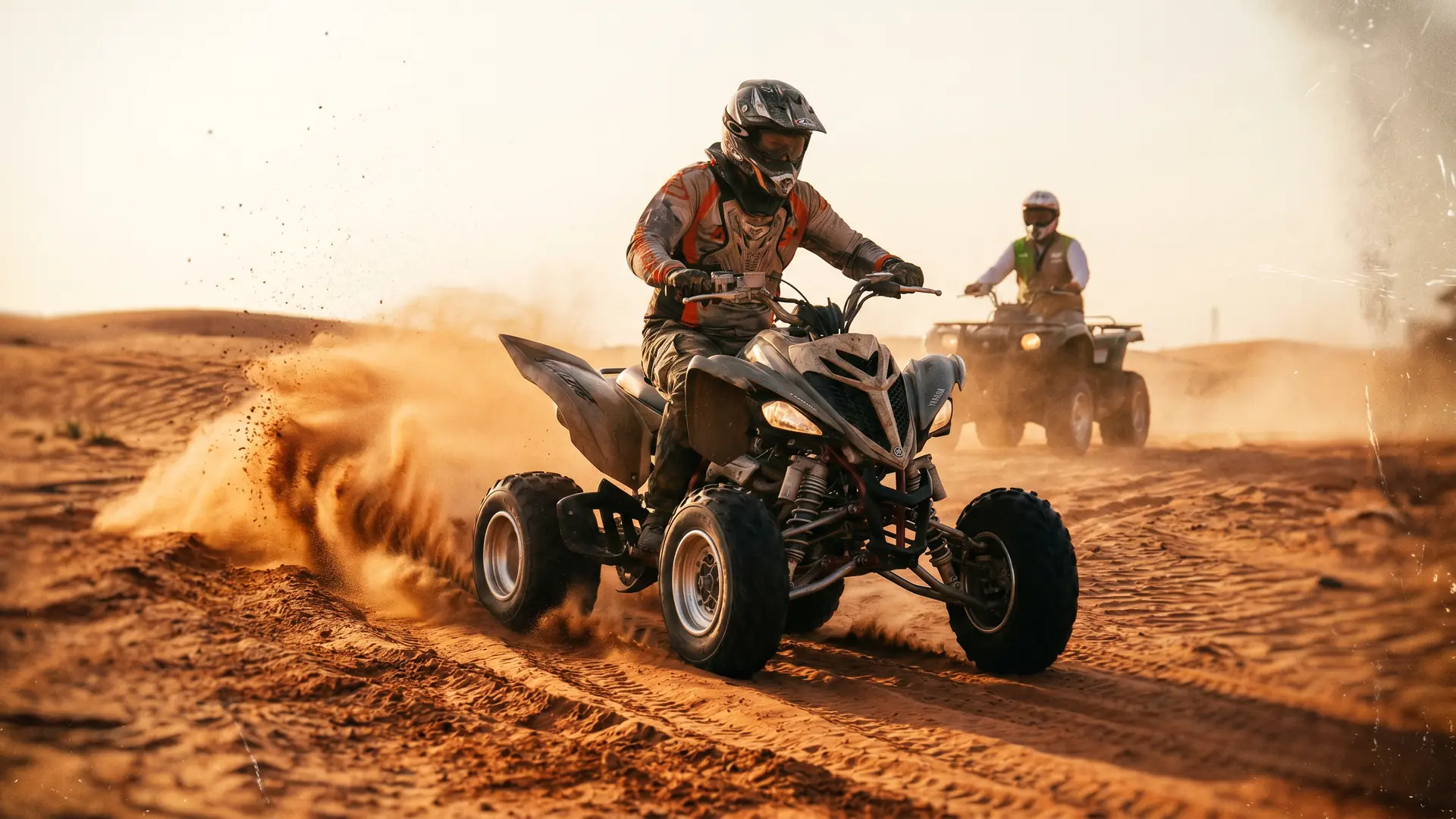 AED 700
Sit still on this one and it fights you. Stand on the pegs, shift your weight into the turn, and it settles.
Book this ATV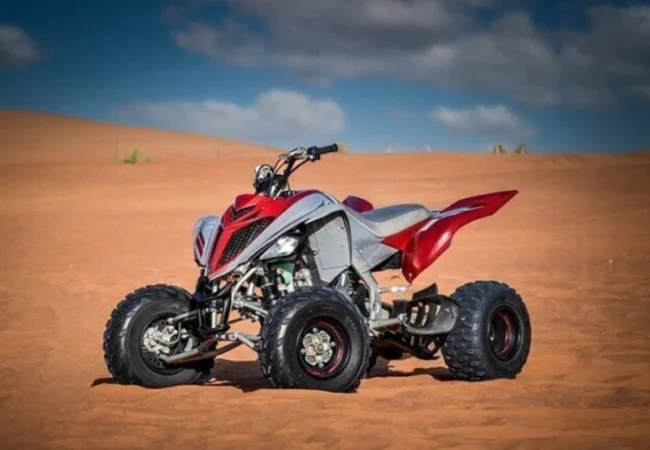 AED 795
Throttle response sharp enough that a lazy hand gets punished right away. The guide asks what you have ridden before handing over the key.
Book this ATVThe ride itself runs about an hour. The drive out costs forty-five minutes each way on top of that. Stack a safari and dinner onto the same trip and the day earns its drive, which is why these combinations outsell a standalone session.
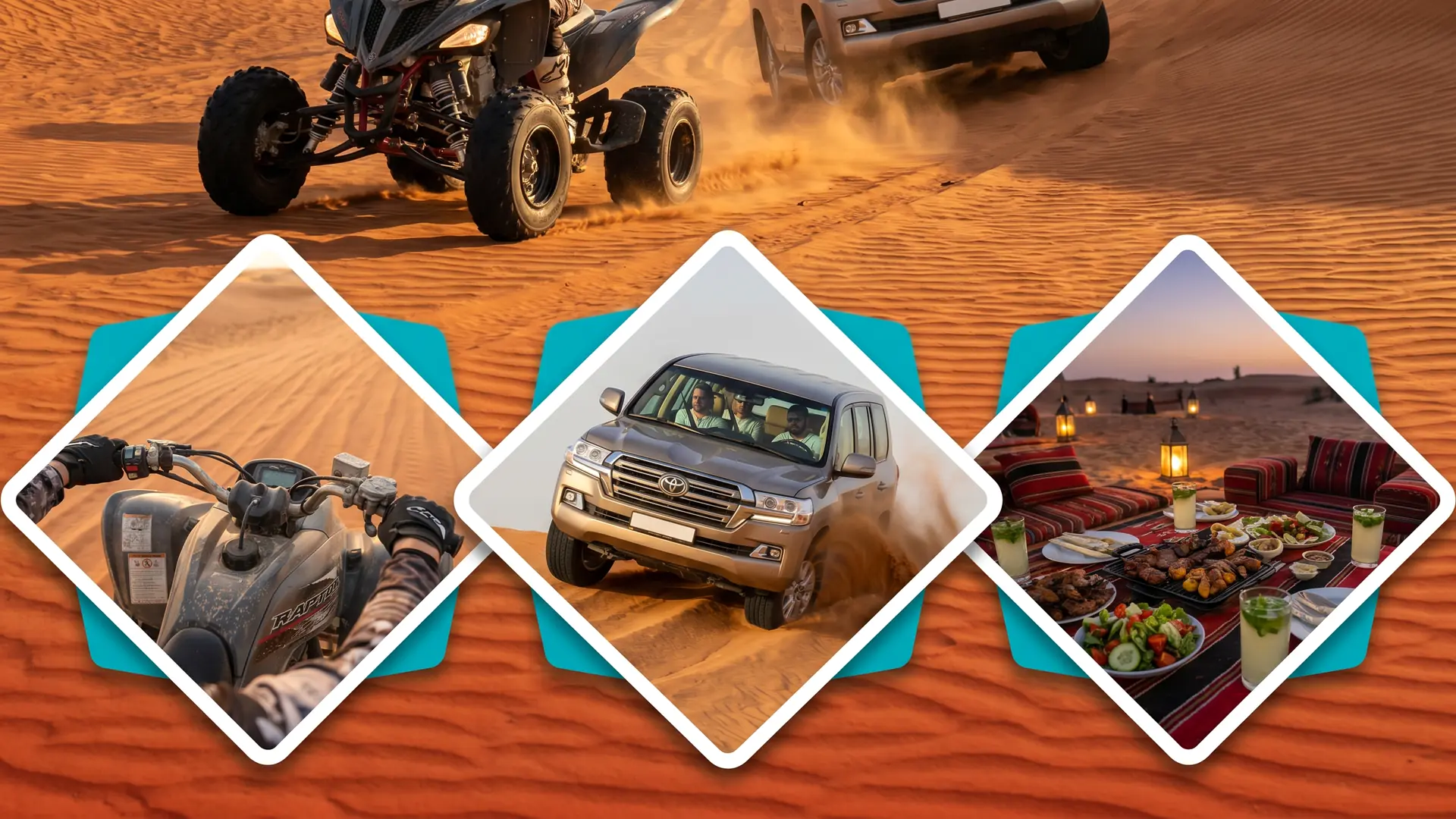 AED 375
Dune bashing in a Land Cruiser first, then your own machine while the ridges turn orange, then the halal BBQ camp after dark. The single most-booked evening on the calendar.
Book this tour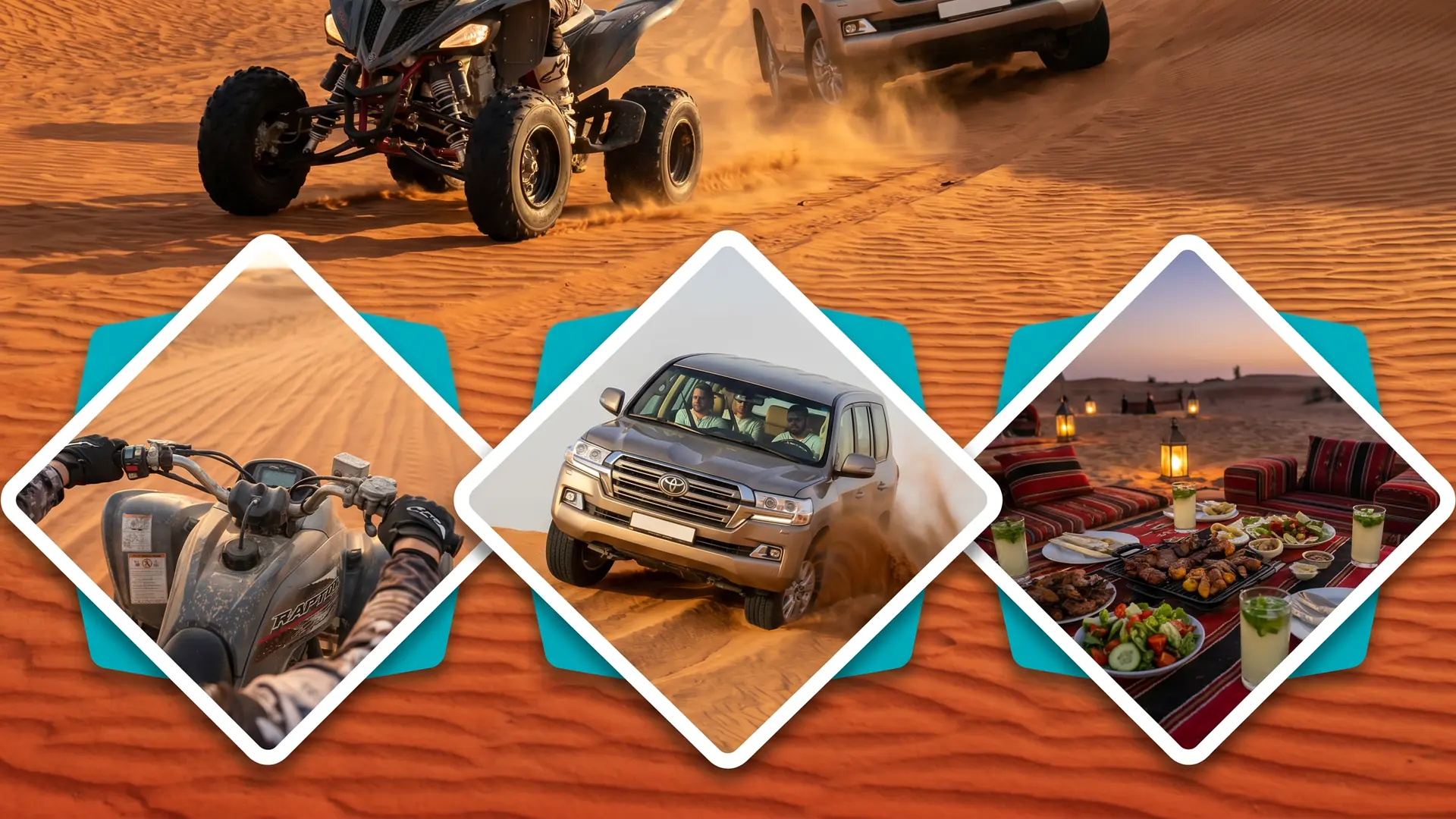 AED 290
Overnight cooling packs the sand firm, so new tyres find grip on the climbs without a fight. You're back in the city well before the afternoon is spent.
Book this tour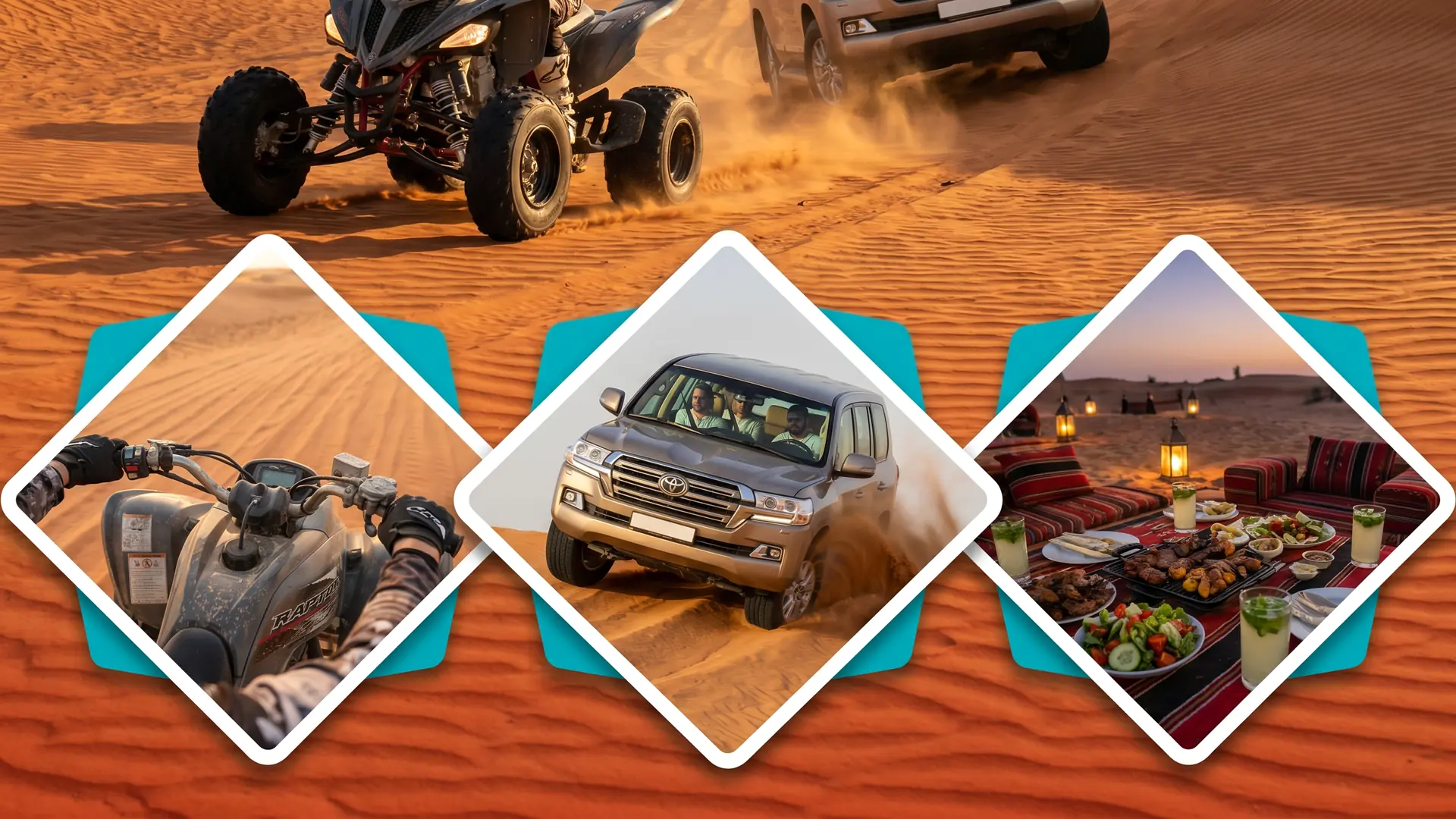 AED 700–1,300
Skips the 4x4 dune bashing for anyone whose stomach does not agree with it. Keeps your own ride and the camp dinner. Price shifts with the machine you choose.
Book this tour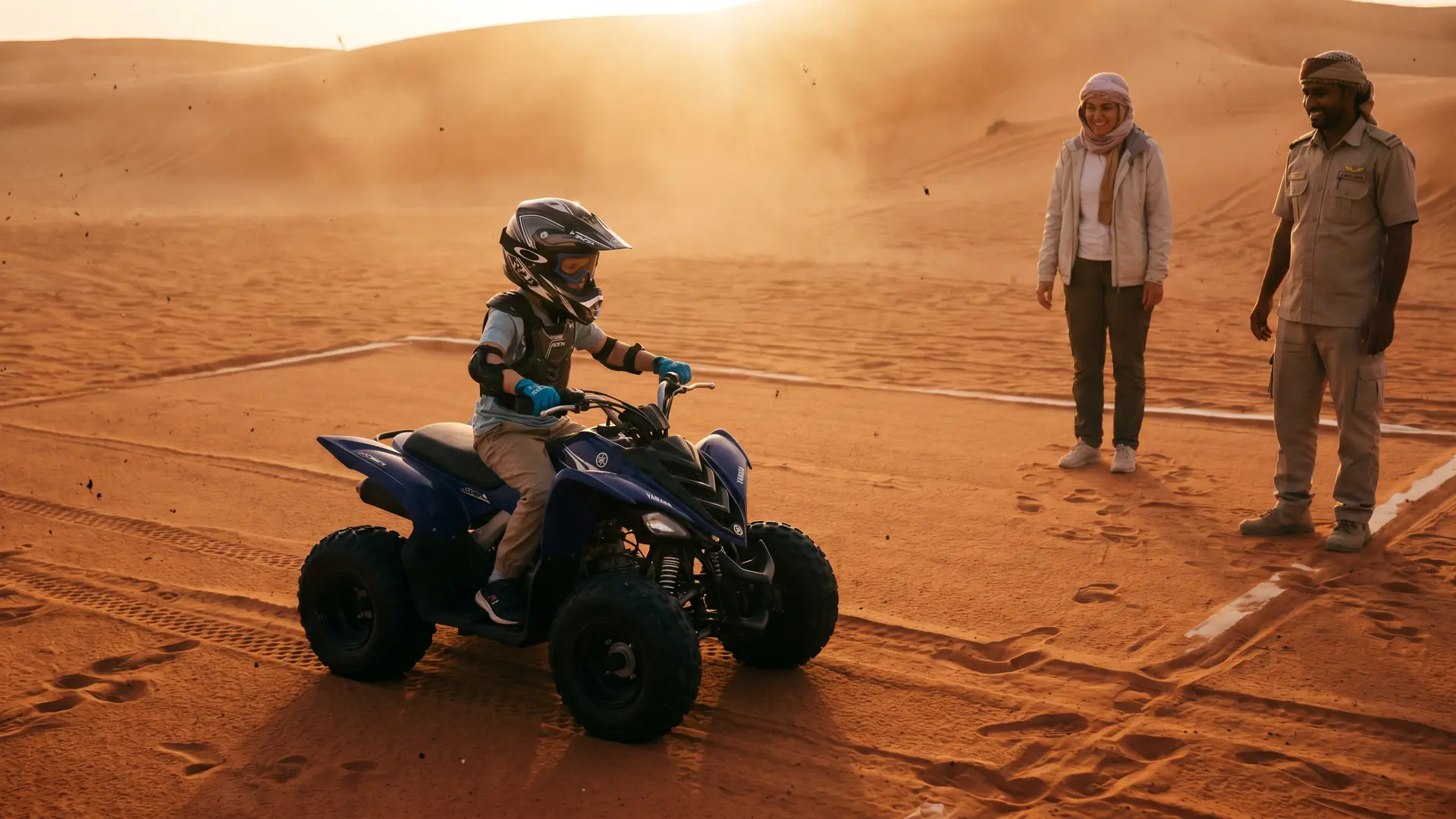 AED 150
Kids loop the 90cc track a stone's throw from where the adults saddle up, both groups riding on the same visit, so nobody spends the trip waiting in a parked car.
Book a family tourNot driving lessons. Anything with a throttle under your right thumb counts.
Where you are staying decides more of this booking than the machine does.
An ATV has you sitting on top of the engine, feeling every bump straight through the seat. A buggy sits you inside a cage, strapped in behind a wheel, with room for passengers. Plenty of riders here book one of each.
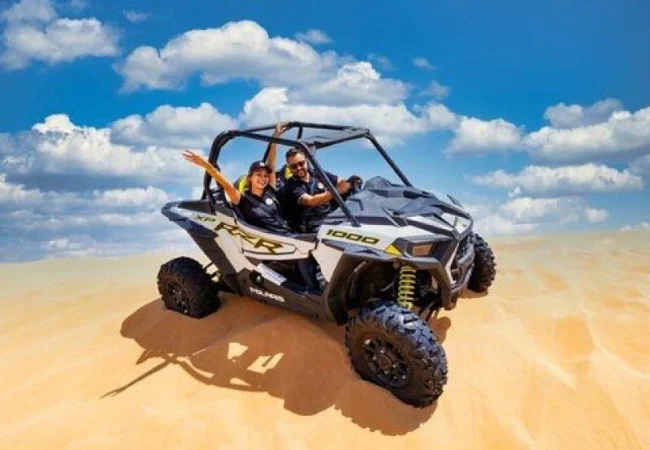
Where most riders start with buggies. Steady under braking, and it forgives a badly judged line rather than punishing it.
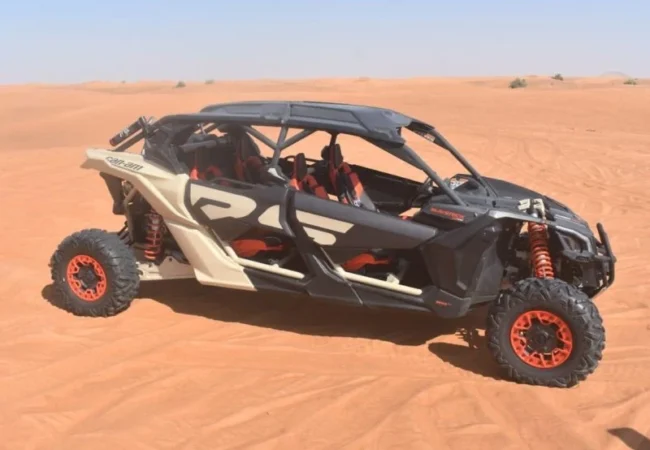
Wide stance and long suspension travel soak up the whoops that would rattle a smaller buggy. One fee covers the whole vehicle, not each seat.
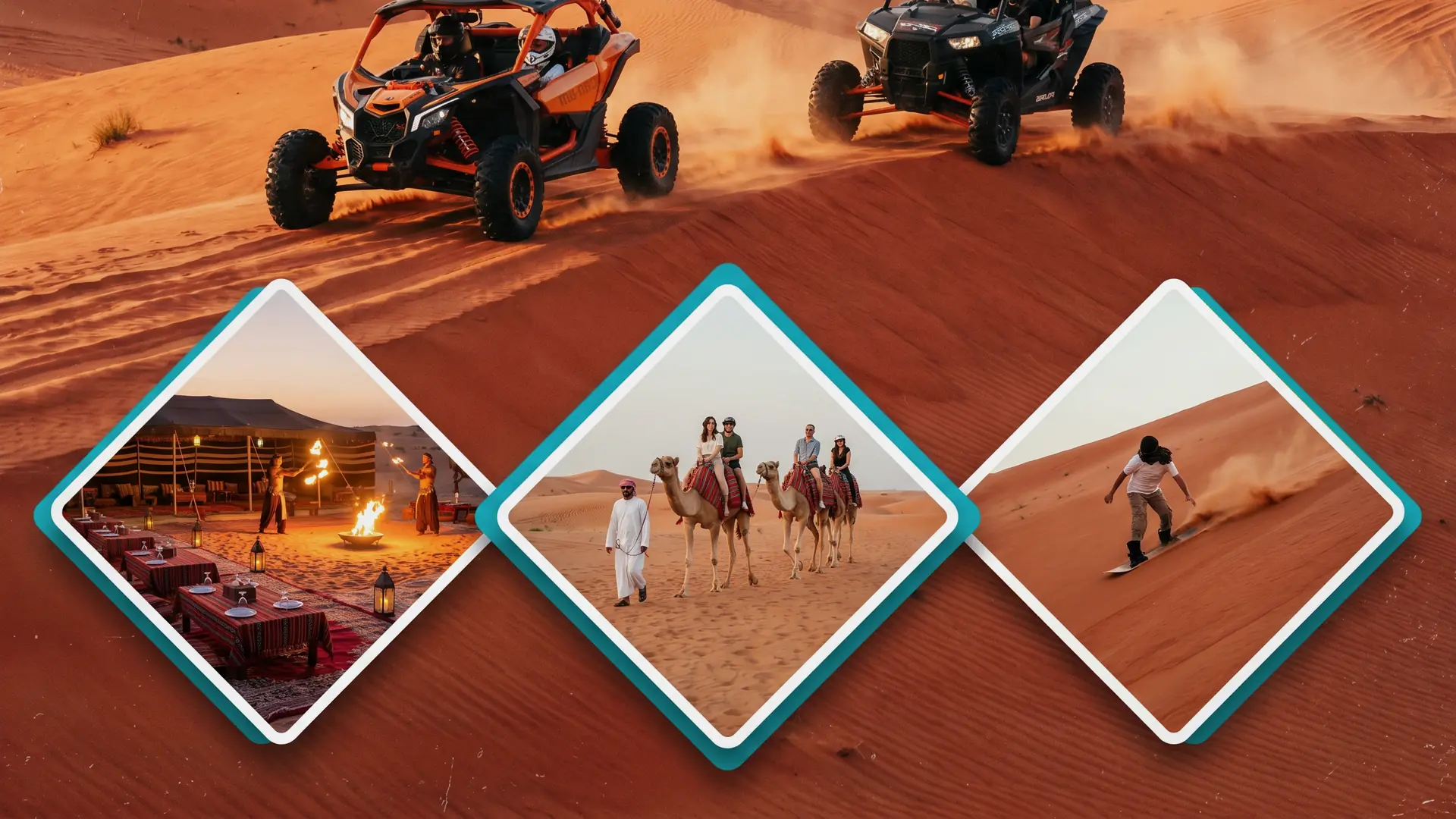
Ride the ATV first while your arms are fresh, move to the buggy once the sun drops lower. Book both together and expect anywhere from AED 290 on the low end up to about AED 1,100 for a fuller combination.
This is the one machine on the page where a conversation happens before a number does. Two wheels expose sloppy technique on soft sand far faster than four ever will, and unlike an ATV, a KTM will not quietly compensate for a rider who is out of their depth.
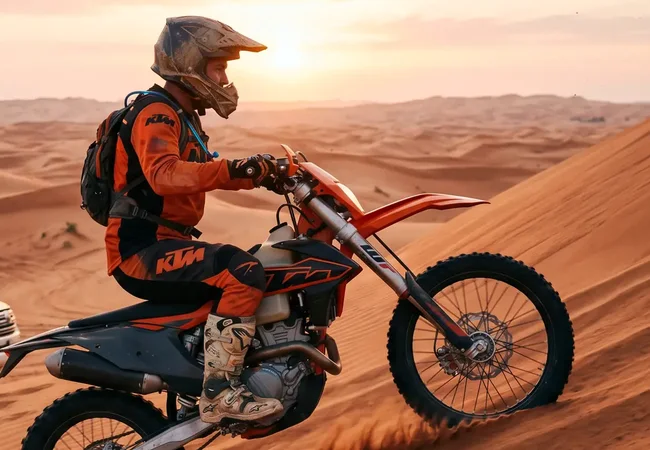
The hour runs AED 850; two hours doubles to AED 1,250. What counts here is logged dirt-bike hours, not enthusiasm.
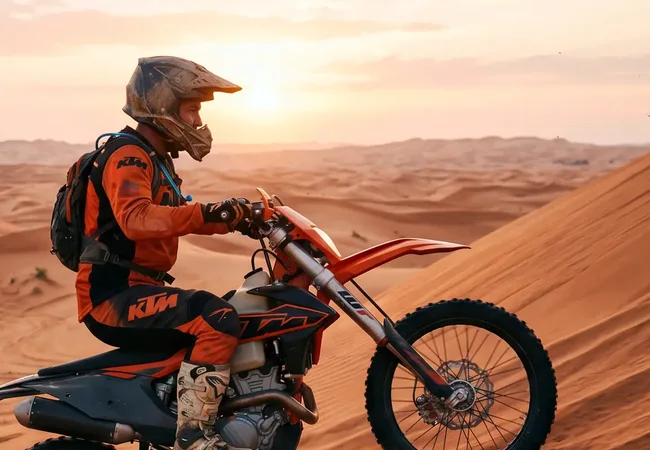
Reserved for the advanced route and handed over only after a rider check. Price confirmed on the day.
Turned away from the KTM? The Raptor 700cc gets you nearly the same pace on four wheels, which plenty of riders end up finding steadier anyway.
Land Cruiser safaris from AED 225 put a professional driver behind the wheel instead of you. Most mixed groups end up booking one alongside the ATVs, for whoever in the party would rather watch than ride.
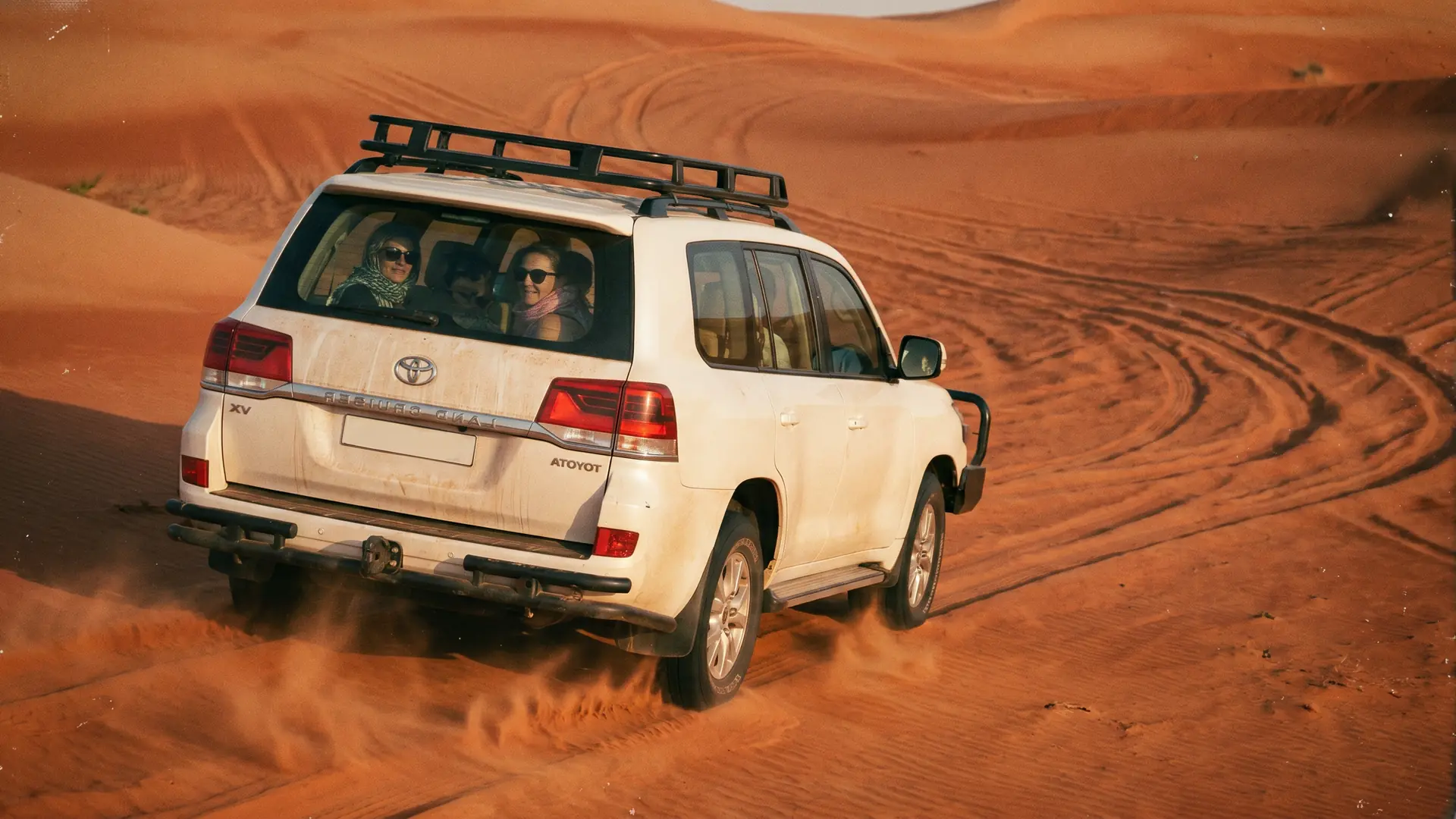
Early pickup, sand still cool from the night, back in the city before lunch service starts.
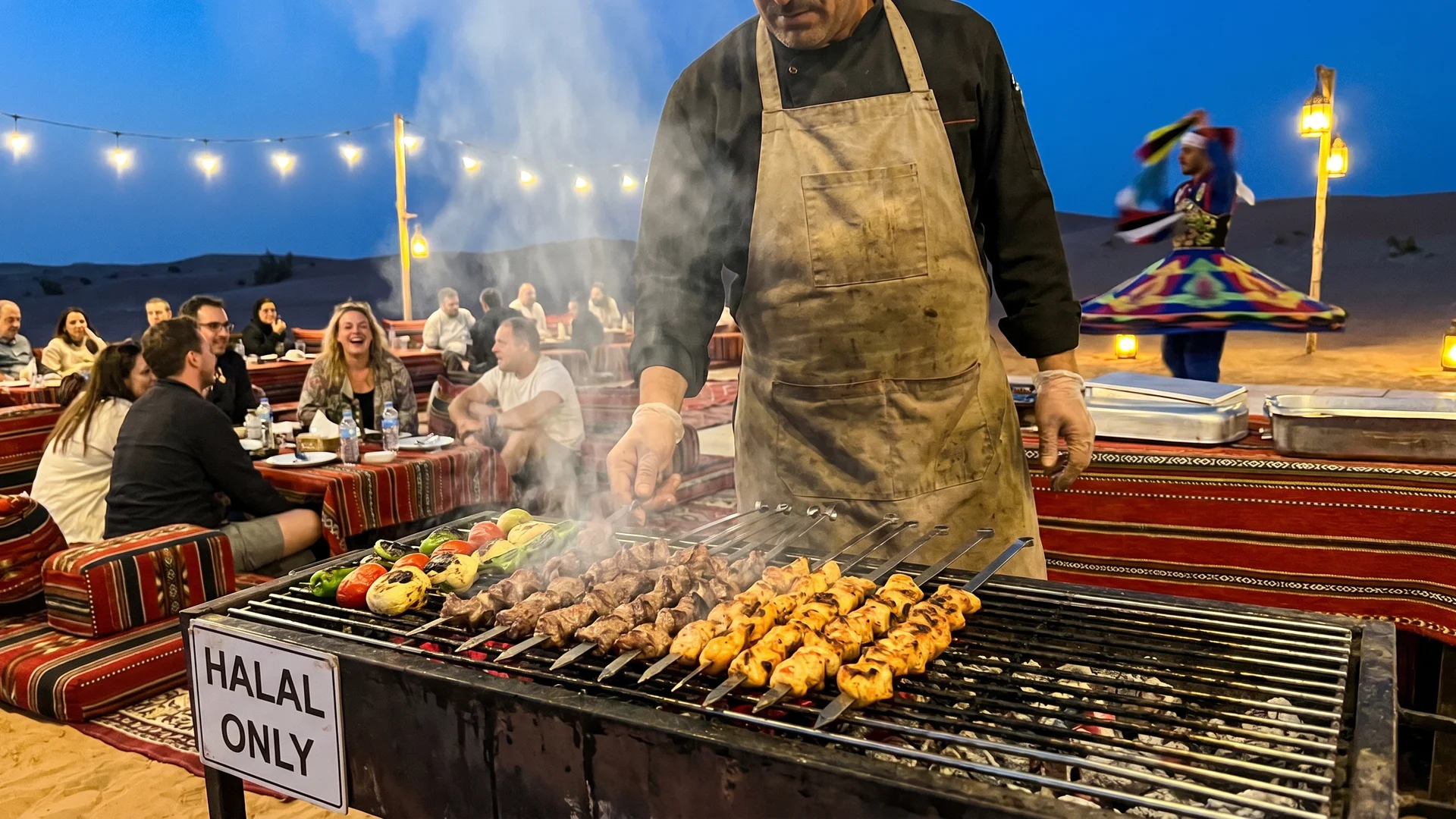
Dune bashing into a dropping sun, the camp, a halal BBQ spread, transfers both directions.
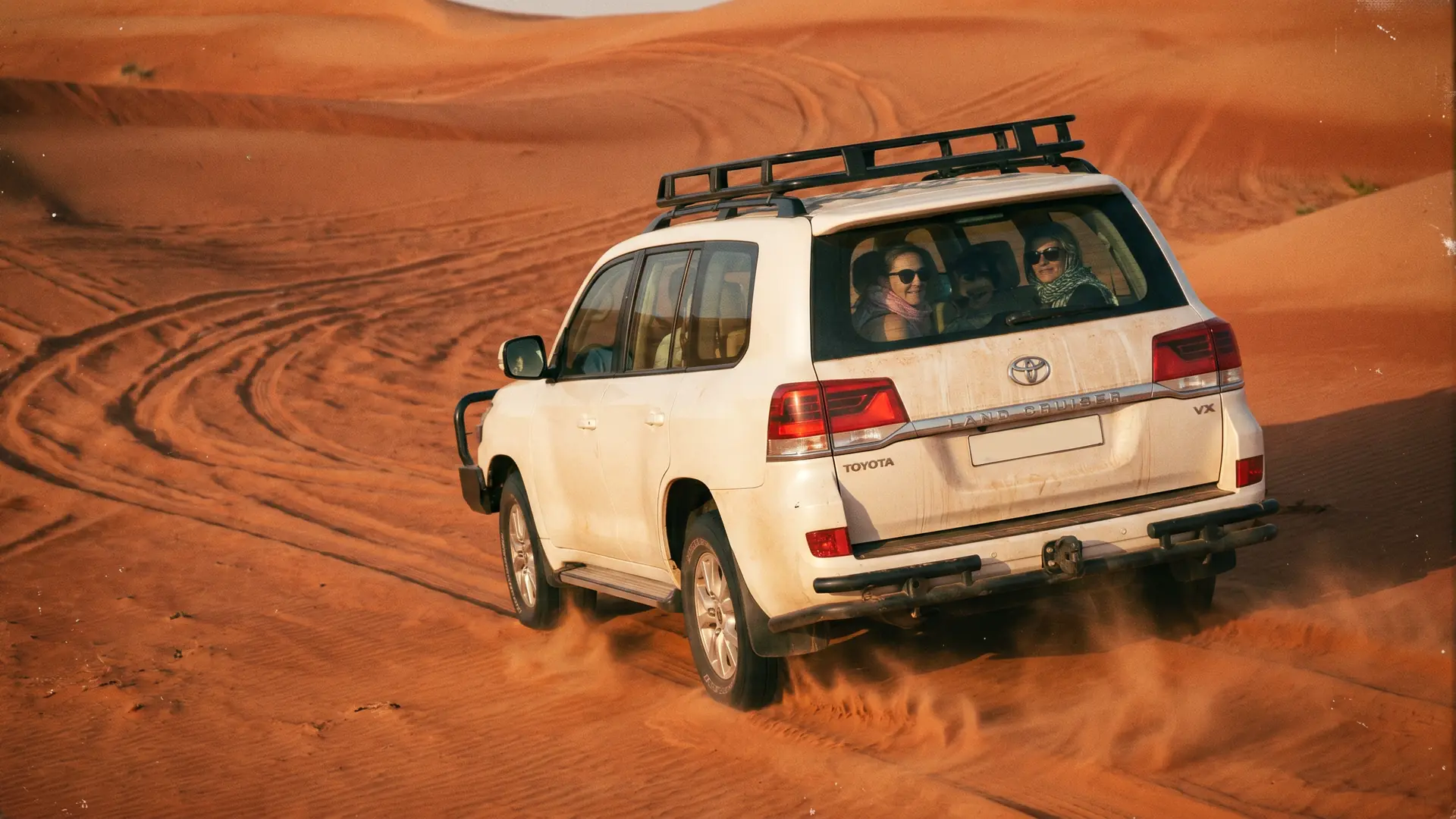
Your own vehicle, your own reserved spot at the camp, everything arranged specifically for your group.
Beyond the standard packages: a private morning run for AED 799, a private evening for AED 1,400, camping overnight, corporate group days, and a gentler route for anyone whose stomach would rather skip the dune bashing altogether.
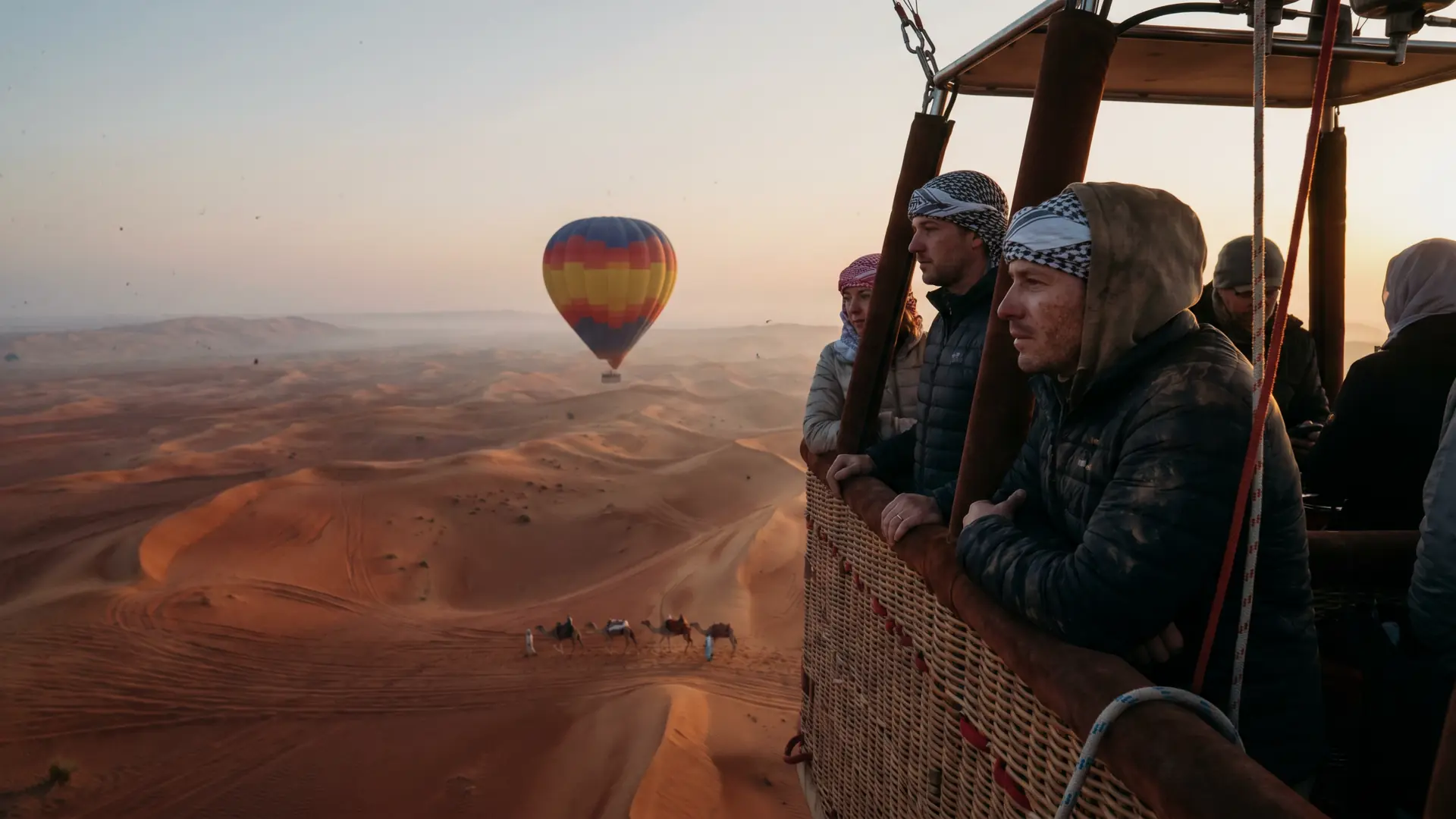
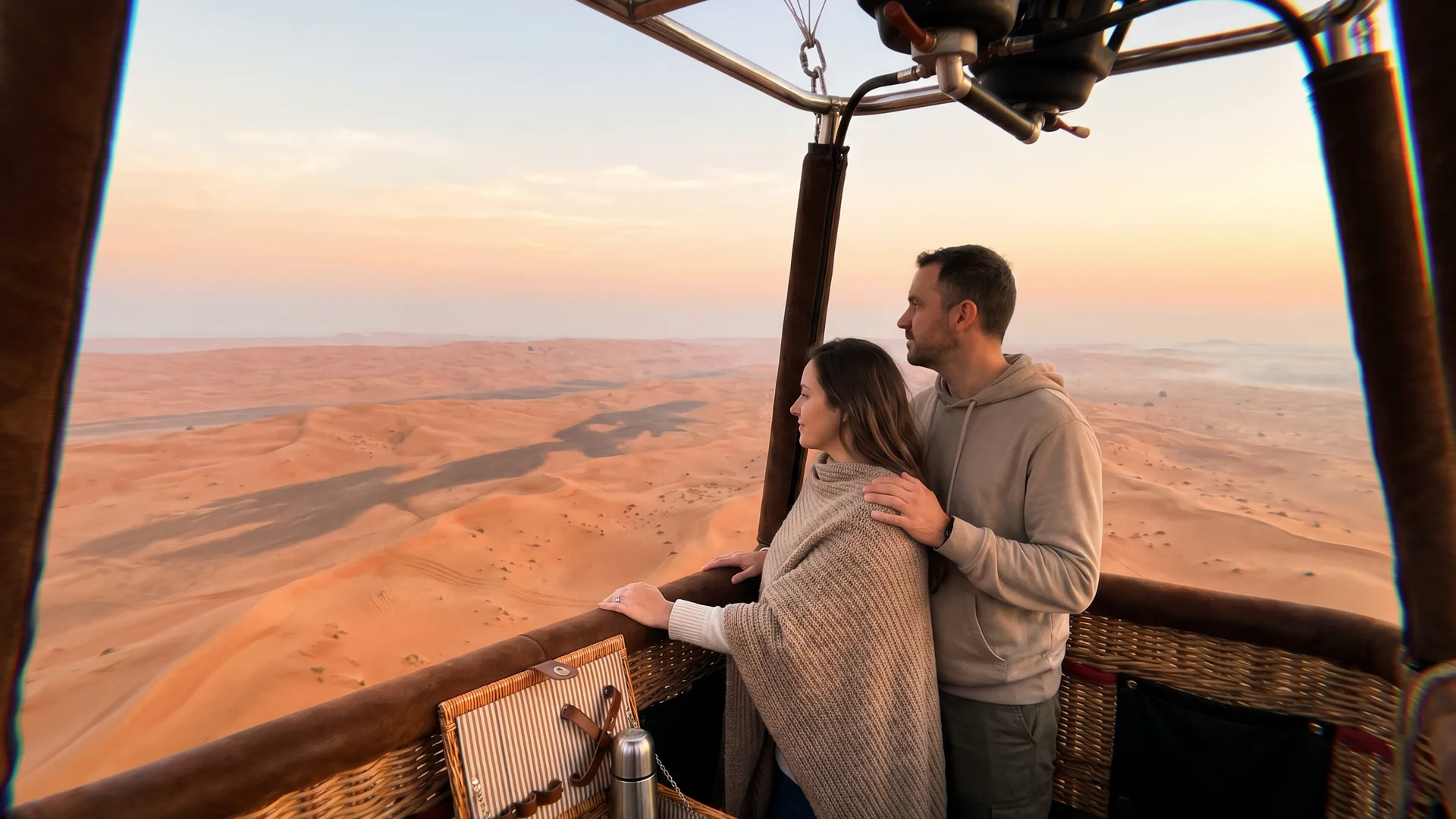
Pickup happens around 4:30 AM, in the dark, and the flight itself is done before most people have poured coffee. Season runs roughly September to May, and nothing else on this page cancels for weather as often.
A good fit for the youngest in your group, grandparents along for the trip, or anyone who watched the Raptor thunder past and felt zero urge to try it.
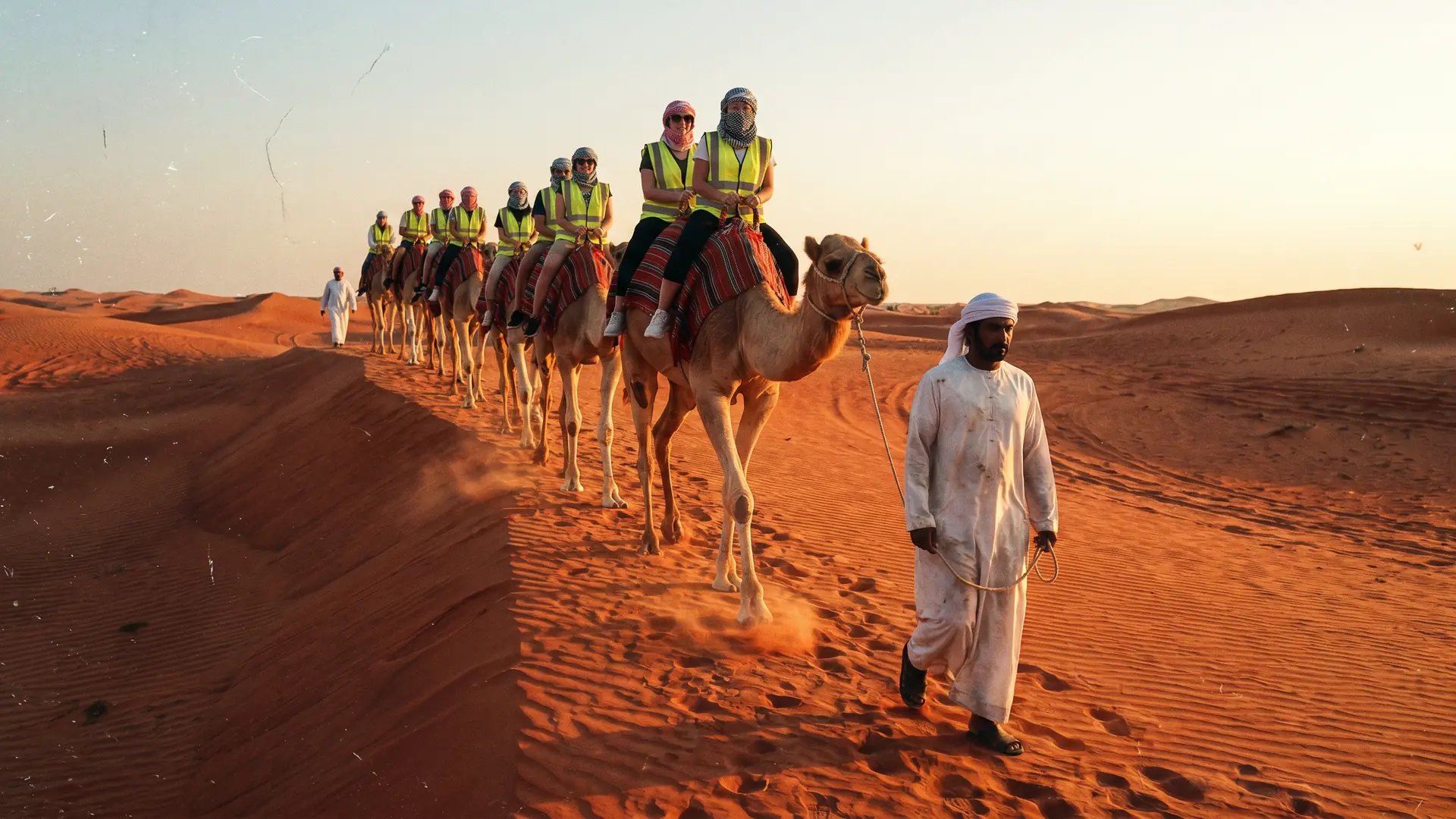
Crosses the same red dunes the ATVs use, just slower and without a throttle involved. Suitable from age three with an adult alongside.
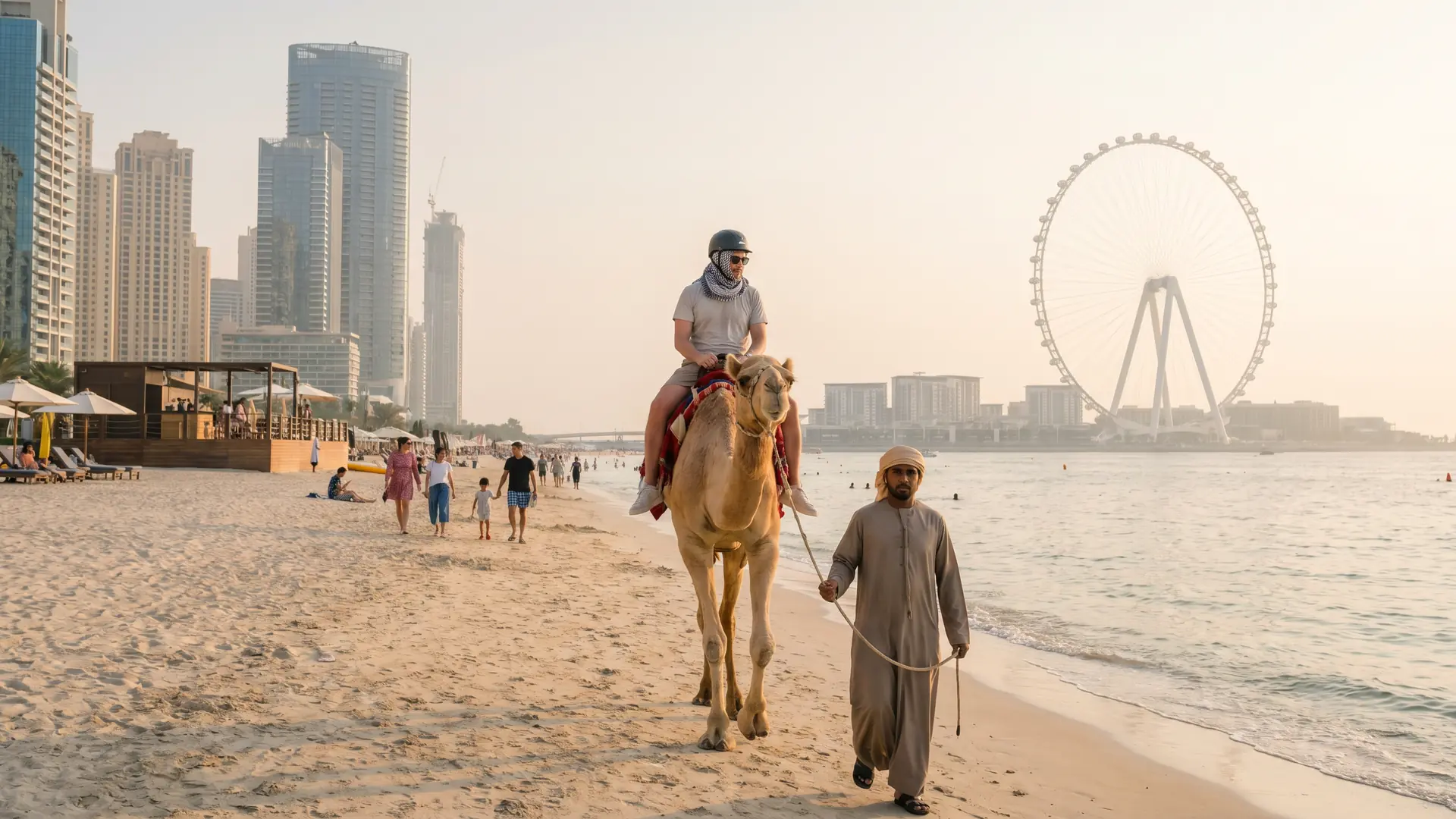
Right in the city on JBR's sand, skipping the desert drive entirely. The shot most visitors actually want for their feed.
For anyone who already has time in a saddle, guided horse riding through the desert is also bookable, starting at AED 575.
Group size, which machines you pick, and how much of the day gets used all swing the final number, so this is not something we can pin to a flat rate. Send those details over and expect a quote within hours.
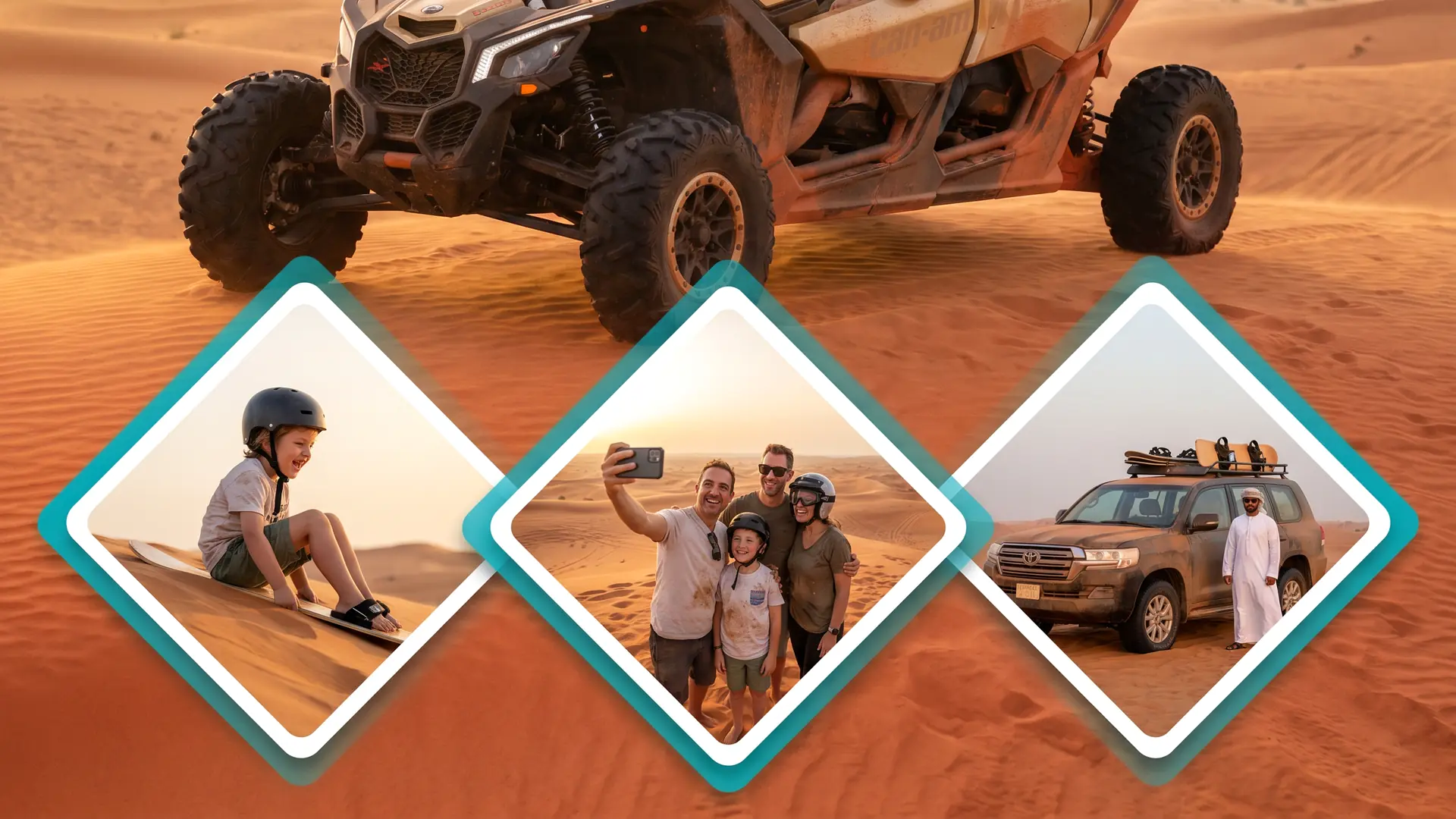
Combine ATV, buggy, safari and dinner and the total typically falls between AED 700 and AED 2,200. Add the balloon at dawn for the ultimate version.
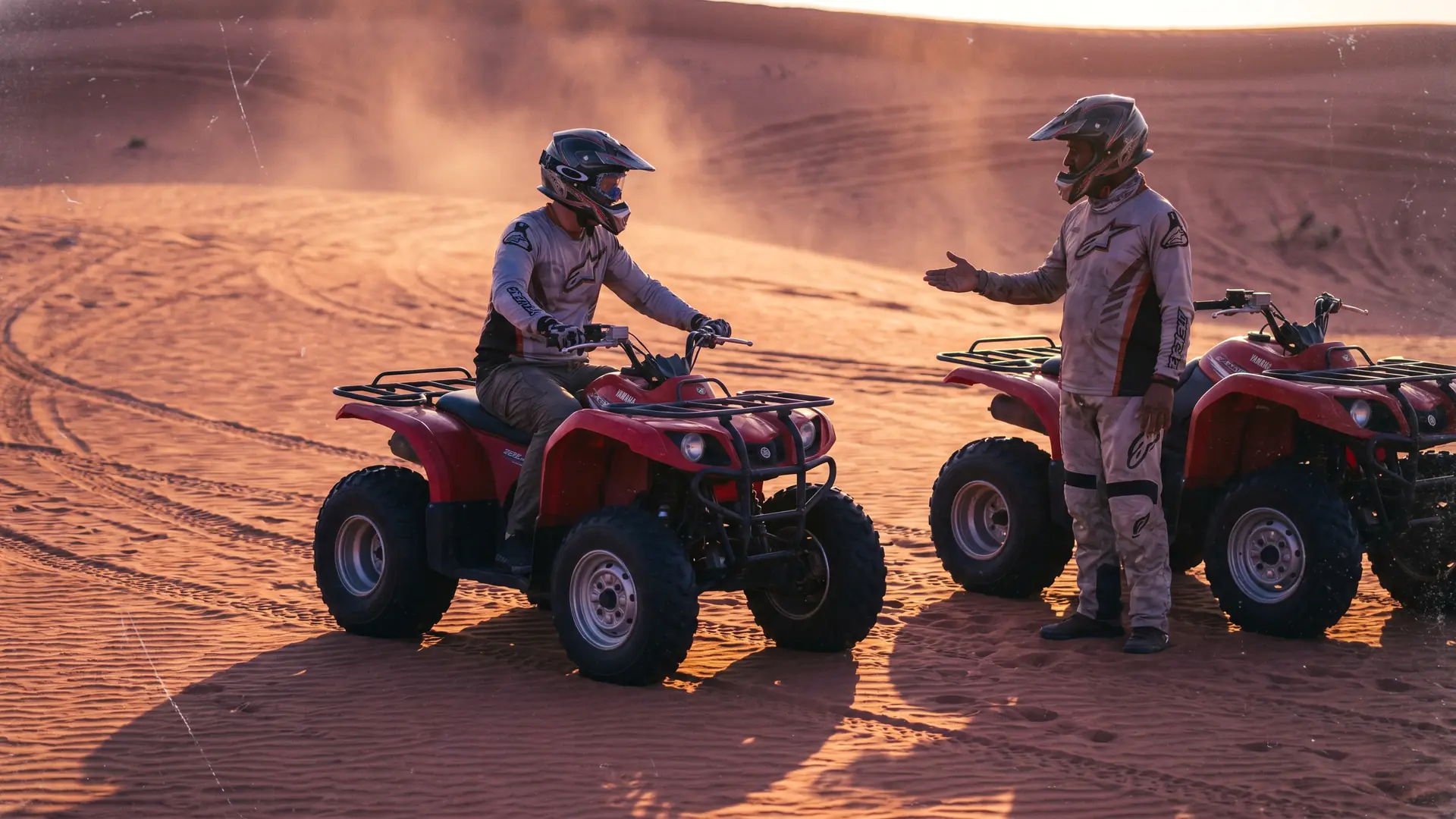
Groups of a dozen or more get split across ATVs and buggies, riding behind the same guides on a schedule that keeps everyone together.
Al Lahbab is where every ATV, buggy and dirt bike session on this site actually runs, southeast of town just off the road toward Al Ain. The colour is the giveaway: proper rust-red dune sand, piled into steep bowls and long ridgelines rather than the shallow mounds you get nearer the city.
The warm-up happens on flat ground right at the base camp. Watching you handle that short stretch is how the guide judges what terrain you are ready for, and that one judgment call is essentially the whole safety system in practice.
Six stages, always in the same order, whether you booked the standard loop or built a full day around it. Only one stage stretches or shrinks depending on what you picked.
Collected from central Dubai, or sent directions to drive yourself once your booking is confirmed.
Helmet goes on first, followed by a walkthrough of throttle, brakes, riding posture, plus the exact signals your guide gives when it's time to stop.
A few minutes on flat sand while the guide watches your hands, then your route for the day gets decided.
Following the lead guide's line across the bowls and ridges, sand kicking up and engine noise filling your helmet, with regular stops to shoot photos.
Water first, then a few minutes for your arms to settle, your photos get handed over, and transfer follows either back to the city or on to whatever else is booked.
Straight from the machine to the halal BBQ camp for anyone riding a dinner package.
Nine-to-twelve-year-olds get the supervised 90cc loop, guardian within arm's reach the whole time. Below that age, a child rides as a passenger in a buggy beside a driving adult, or sits on a camel once they turn three. If something about your group needs flagging, say so at the time of booking rather than saving it for the briefing. Dream Land Adventure Tourism is the licensed operator behind all of this, DTCM paperwork included. From that point on, whatever the guide decides in the moment is what actually governs the ride, not a policy document.
Based on 758 Google reviews
Based on 1,142 reviews
Per rider, not per group: AED 200 is the floor on the 220cc, AED 795 the ceiling on the Raptor 700cc. Most people end up gripping the 250-dirham 400cc for their session. A separate, cheaper loop exists for nine-to-twelve-year-olds, AED 150 on the supervised 90cc track. Pair riding with a Land Cruiser run and camp dinner and the number moves to AED 290 for a morning slot, AED 375 once it is evening.
Yes, same machine under two names. ATV is what North Americans call it; quad or quad bike is what gets said across the UAE and UK. Every price and listing on this page points at the identical fleet either way.
Southeast of the city, off the road toward Al Ain, sits Al Lahbab: the genuine red-sand terrain, roughly three-quarters of an hour from Downtown by car. Skip the bleached, flattened sand nearer the highway; it photographs grey, not red. Anyone hunting for real dune riding rather than a roadside patch ends up here, since nothing closer to town matches the colour or the terrain.
None needed. This runs on private land, so public-road rules do not apply. Never gripped a throttle before? The 220cc handles that, provided you flag it during the briefing rather than staying quiet about it. That first stretch on flat sand exists purely so your guide can judge what you can handle before the terrain gets serious.
You have your own machine, but you are never out there alone. A lead guide rides ahead, sets the line, keeps spacing between riders and calls every stop. Pace follows whoever is slowest in the group, not whoever is fastest.
The 90cc loop takes riders from nine up to twelve, always with a guardian close by, for AED 150. Below that age, riding your own machine is not on offer, but a child can still ride along as a buggy passenger next to a driving adult, or sit on a camel starting from age three instead.
Nothing about pickup is bundled into the base price; it gets quoted and locked in before payment. Business Bay, Downtown, JBR, Deira and the Marina area are all standard runs. Prefer to drive out yourself? Directions arrive as soon as your booking is confirmed.
Set aside roughly half a day, once travel is factored in. The actual session on the dunes covers one loop, but reaching Al Lahbab and returning eats about forty-five minutes on each leg from the city centre. That drive is exactly why so many riders bolt on a safari or camp dinner rather than making the trip out for a single short ride.
Shoes need to be closed-toe, no exceptions, plus sunglasses and an outfit you will not mourn if sand wrecks it. A helmet comes with the booking. Nothing on the list matters more than something covering your nose and mouth, whether that is a buff, a scarf, or a bandana. Pack a spare outfit too; the ride home is more comfortable in clean, sand-free clothes.
Somebody always circles back for you, no drama attached. Nearly every session sees at least one rider bog down, usually from backing off the throttle mid-climb on soft sand rather than powering through it. It costs nothing and eats maybe a minute or two out of your ride.
If every person in your party wants to be the one steering, ATVs make sense, since each rider pays their own way. When only a driver or two actually wants control, a buggy works out cheaper, because the fee attaches to the vehicle rather than the headcount. A group spanning nervous and confident riders alike often ends up booking a mix of both, staying together on one guided route.
It runs year-round, but summer bookings cluster at sunrise and just before sunset. Between late May and September, midday sun on open sand turns brutal fast, so slots move to the cooler edges of the day. Outside that stretch, October through April, any daylight hour works.
Wind and sandstorms trigger a reschedule, not a cancellation, and someone reaches out beforehand with new slot options at no added cost. This activity tolerates rough weather better than most listed here; it is the balloon flights that actually get grounded.
Midweek dates need only a couple of days' notice. Weekend slots, Friday and Saturday especially, book out further ahead, so aim for a week or more if those are the only days that work for you. Late-afternoon departures and the Raptor 700cc go earliest. Secure online advance payment confirms your booking, support available 24/7.
An ATV ride is the physical act of steering your own Yamaha through real dune terrain at Al Lahbab, one rider per machine, throttle and body weight doing the work rather than a screen or a seatbelt. Prices run from AED 200 up to AED 795 depending on rider ability; the 400cc carries most sessions at AED 250. The 90cc option for riders nine to twelve, always supervised, sits at AED 150 on its own separate loop.
Nothing else on the booking sheet outsells the Evening Desert Safari with ATV and BBQ at AED 375, pairing your riding session with dune bashing and dinner at the camp. Secure online advance payment confirms your booking, support available 24/7.
The grip and pull most riders remember afterward.
AED 250Dune bashing, your own ride, dinner under the stars.
AED 375Soft throttle response built for a first time on sand.
AED 200Ages nine to twelve, a guardian watching every lap.
AED 150Sharp throttle response, released only after a rider check.
AED 795Cooler air and overnight-packed sand for new riders.
AED 290Same dunes, a wheel and harness instead of a grip.
AED 599Up in the sky while the ATV fleet is still parked and quiet.
AED 1,049Vibration through your hands and feet first, then the back end stepping sideways as the tyres search for grip, then a half-second of weightlessness at the top of every bowl before gravity takes the front wheels back down.
Nobody describes an ATV ride accurately from a photograph, because the photograph cannot show you the part that actually registers: the ground is never flat for longer than a few seconds. Sand gives under the tyres in a way asphalt never does, so the machine is constantly correcting itself under you, a small side-to-side wander that your hands learn to read within the first few minutes. Throttle input on sand is not linear either. Roll it on too fast and the back wheels spin loose before they bite, throwing a fan of sand out behind you that you feel more than see, since it is happening behind your shoulders.
Climbing a face changes the sensation completely. The engine note climbs with the slope, the whole machine tips back so you are leaning into the handlebars rather than sitting square, and there is a specific moment near the crest where the front wheels go light and the machine seems to hang before it drops onto the falling side. New riders brace for that drop. Experienced ones lean into it and let the suspension do the work, which is the difference a single session is usually enough to teach.
Heat and noise are part of the sensation too, not an afterthought. The engine sits close enough that you feel its warmth through the footpegs on a long climb, and with a helmet on, your own breathing gets loud in a way it never is anywhere else. None of this shows up in a brochure photo of someone smiling on a stationary quad. It only shows up once the throttle is actually open.
Descending is a different sensation again from climbing, and it catches almost everyone off guard the first time. Gravity does the work instead of the throttle, which means the instinct to grab a fistful of brake is usually the wrong one: too much front brake on a steep face and the machine wants to pitch forward rather than settle. Guides teach a light touch on the way down, weight back, letting the machine roll rather than fighting it, and by the second or third descent most riders have stopped white-knuckling the levers.
A fairground quad runs on a fixed loop at a capped speed with a rubber curb keeping you honest. This runs on open dune terrain that changes gradient every few seconds, with a guide reading your ability rather than a timer cutting your go short.
A surprising number of first-time bookings arrive expecting something closer to the coin-operated ride outside a shopping mall: sit down, twist a throttle that is mechanically limited to walking pace, follow a painted line for ninety seconds, get off. That machine exists to be safe for anyone regardless of skill, which means it removes every variable that makes riding interesting. Nothing about the terrain changes. Nothing about your input changes the outcome much.
An ATV ride here removes the ceiling instead of building one in. The 220cc still keeps a nervous first-timer well within control, but the throttle response is real, the terrain genuinely shifts under the tyres, and your steering, weight and throttle timing all change how the next thirty seconds go. Two riders on the same machine on the same route will have noticeably different rides, because the machine responds to the person, not the other way around.
The other difference is duration and terrain variety. A fairground ride is one loop, one gradient, one outcome. A guided session moves through several distinct bowls and ridge lines over the course of an hour, each one asking something slightly different of your hands. By the third or fourth climb, most riders have stopped thinking about the controls consciously and started reacting, which is roughly the point where people say it stopped feeling like a ride and started feeling like riding.
Yes, and it is the most common starting point rather than the exception. The 220cc, the warm-up assessment and a guide who paces the group around the slowest rider exist specifically to turn a shaky first attempt into a good one.
Nerves before a first ride are close to universal, and the guides have seen every version of them: white knuckles on the handlebars, a rider who wants to go noticeably slower than everyone else, someone who says they are fine and is visibly not fine. None of that is treated as a problem to solve quickly. The warm-up on flat sand before the real route exists precisely to let a nervous rider find their hands without an audience, and the guide watches that stretch closely rather than rushing through it.
Fitness matters less than people assume, and differently than they expect. This is not a cardio activity in the way a long hike is. What it actually asks of your body is grip strength in your forearms, the ability to shift your weight forward and back as the terrain changes, and enough core stability to stay loose rather than rigid over bumps. Riders in their fifties and sixties book this regularly and manage it without issue, while a fit twenty-five-year-old who rides completely stiff-armed will tire out faster than either of them, because rigid arms transmit every bump straight into your shoulders.
What actually gets managed, deliberately, is pace and route. A nervous or less fit rider gets a gentler line through the same terrain, fewer aggressive climbs, more flat stretches to recover on, and a guide checking back over their shoulder more often. Say so before the warm-up rather than pushing through it silently. Guides adjust to what they see and hear, and a rider who admits to being nervous almost always ends up with an easier, more enjoyable session than one who pretends otherwise and gets in over their head on the second climb.
From the guide's side, a nervous rider is easy to spot within the first thirty seconds of the warm-up: shoulders up near the ears, throttle applied in short nervous stabs rather than one smooth roll, eyes fixed on the front wheel instead of looking ahead. None of that gets pointed out loudly or made into a moment. Guides talk riders through it quietly, one instruction at a time, usually starting with something as simple as asking them to look further down the track rather than at their own hands.
The kids' 90cc runs as repeatable laps on a marked track, built for short bursts. Every adult booking here runs the same format instead: one continuous guided session of roughly an hour, not a series of short taster loops.
Some operators around Dubai sell a scaled-down taste, a few minutes on a short loop close to the parking area, mostly aimed at visitors who want a photo more than a ride. That format exists and it has its place, particularly for the 90cc kids' track here, where short, repeatable laps let a child get on and off several times without ever losing a guardian's sightline.
Adult sessions are built the other way around. Once the warm-up is done and the guide has read your control, the route runs continuously through the dune bowls for about an hour before you loop back, rather than stopping and restarting on a short circuit. The first ten minutes are usually spent adjusting to the throttle and the terrain; the real riding, the part where your hands stop thinking and start reacting, tends to start somewhere after that.
This is worth knowing before you book, because a rider expecting a quick five-minute taste and a rider expecting a full session are planning two different afternoons. If your only goal is a photo on a quad, a shorter activity elsewhere might suit you better. If you want to feel what riding on sand actually does over a real session, build an hour of riding, plus briefing and warm-up either side of it, into your plan, rather than arriving with the wrong expectation and leaving disappointed.
You are the only person on your machine, but you are never actually riding alone. A lead guide rides ahead the entire time, and for most of the session you can see their dust, hear their engine note change before a climb, and read their body language in real time.
The word solo gets used two different ways around this activity, and it is worth separating them. Solo as in one rider per machine: yes, correct, nobody shares a seat unless you have booked the 400cc double. Solo as in unsupervised, out in open dunes with nobody watching: no, and that distinction is the entire safety model. The guide rides a machine of their own, ahead of the group, the whole time.
What that actually feels like from the saddle is closer to following a lead climber on a rope than riding in convoy traffic. You are watching the guide's line into every bowl a few seconds before you reach it yourself, adjusting your own approach based on what you just saw them do. Their signal is really their body position: leaning back into a descent, standing on the pegs before a rough patch. Riders pick up on these cues faster than they expect to.
Spacing between riders gets actively managed too, not left to whoever happens to be quickest off the line. Too close and you are riding in someone else's dust and sand spray; too far back and the guide loses the ability to signal you. Guides adjust the gaps as the group settles in, tightening or loosening the line depending on confidence. By the second or third bowl, most groups have found a natural rhythm where nobody feels crowded and nobody feels abandoned, which is really the guide's doing more than the riders'.
Riders who want to push harder than the group pace sometimes ask about overtaking, and the honest answer depends on the guide and the terrain that day. On wide, open stretches, a confident rider might get waved past to open up some space; in the tighter bowls, everyone holds position because there is simply nowhere safe to pass. Wanting to go faster is normal and never discouraged outright, it just gets managed rather than handed out unconditionally.
Forearm ache first, from gripping harder than necessary the whole session. Then a low adrenaline comedown on the drive back. Then sand in places you will be finding for the rest of the week.
The forearm burn is the most universal complaint, and it is almost always a grip problem rather than a fitness one. First-time riders hold the handlebars far tighter than the machine actually needs, bracing against every bump instead of letting their arms absorb it, and that tension shows up as an ache from wrist to elbow within the first twenty minutes. It fades within a day or two, and riders who come back for a second session almost always report it happening less the second time, purely from relaxing the grip a little.
The adrenaline drop afterward catches some riders off guard. A specific quiet settles in during the drive back to the city, somewhere between satisfied tiredness and the mild flatness that follows any spike in adrenaline once it passes. Drink water at the return point rather than skipping it because you feel fine; heat and adrenaline together mask dehydration more than people expect, especially on afternoon sessions.
Sand gets everywhere, and that is not an exaggeration for effect. It ends up in boots, in pockets, worked into hair under a helmet, and in the seams of clothing you will still be finding grains in after a wash or two back at the hotel. A change of clothes for the ride home and a proper shower afterward genuinely improve the rest of your evening. None of this is a complaint about the activity so much as an honest debrief of what an hour on real dunes does to a body, so it does not catch you off guard.
One session is enough to say you have properly done it. Whether it is enough for you personally usually becomes obvious in the last fifteen minutes of that first ride, once the nerves have burned off and the machine finally starts to feel familiar.
A single guided session gives you the whole experience end to end: briefing, warm-up, a real route through changing terrain, and the return. Nothing about a second visit changes that fact. If your goal was to try it once, feel what it is like, and get the photos, one ride does the job completely and honestly.
What tends to change people's minds is timing rather than dissatisfaction. The first twenty minutes of any session go toward learning the machine and the terrain, which means the most comfortable, most confident riding of the whole hour usually happens right near the end, just before you turn back. Riders who loved that last stretch and wished it had started sooner are the ones who come back and book the 400cc turbo or the Raptor next time, already past the learning curve from session one.
There is no obligation either way, and nobody upsells a second ride on the strength of the first. If you are weighing it up, the honest signal is how the drive back felt: tired but grinning tends to mean book again on a future trip; tired and simply relieved to be done is a perfectly fine place to leave it. Both are common, and the machines here range widely enough, from the 220cc up to the Raptor 700cc, that a second visit rarely means repeating the same ride twice.
Some riders come back specifically for a different machine rather than a repeat of the same one, moving from the 220cc to the 400cc a season later, or working up to the Raptor once the nerves from a first attempt have fully worn off. Others return for the same machine at a different time of day, chasing the light of a sunset session after only ever riding at midday before. Neither reason needs justifying; both come up often enough that guides recognise returning riders more than you might expect.
No. ATV controls are simpler than a motorbike's: twist throttle, squeeze brake, no clutch or gears to coordinate. Riders with zero two-wheel experience handle the 220cc and 400cc without issue, since balance is not the challenge an ATV asks of you.
Not recommended once you are moving. Sand kicked up by the rider ahead reaches your face at any real speed, and goggles or a closed visor are the only thing standing between that and your eyes for the whole session.
Usually, yes, unless you have booked a private slot. Solo travellers and small groups join the day's scheduled riders behind the same guide, which most people end up enjoying rather than minding, since the group sets a natural rhythm.
Automatic. Every machine on the fleet uses a twist-and-go throttle with no clutch or gear shifting required, which is exactly why first-time riders can be capable within the warm-up rather than needing a lesson first.
Yes, mounted securely rather than held. A chest or helmet mount survives the vibration and the bumps; a hand-held phone usually does not survive the first proper climb.
A few slow laps on flat sand near the base, throttle and braking only, no dunes involved yet. The guide watches how smoothly you control speed and steer, then sets your route and your position in the group based on what they see.
Not hurt in the sense of pain, more a novel kind of tired. Expect forearm fatigue from gripping and a stiffness through your core the next morning if you have not used those muscles this way before. Nothing that lasts more than a day or two.
Yes. Mixed bookings, one rider on a 220cc and another on a Raptor, ride in the same group behind the same guide, who adjusts the pace so neither rider is left waiting or struggling to keep up.
Yes, secure storage sits at the base while you ride, so you are not carrying a wallet or phone loose in a pocket through the dunes. Take only what is mounted securely to the machine or your body.
The roster rotates, but every guide runs the same warm-up, spacing and route-matching process. Consistency comes from the method, not from getting a specific individual, so the experience does not depend on who happens to be on shift.
Choose a machine, secure it with online payment, and get your exact pickup slot the evening before over WhatsApp.